
The 2025 US National Security Strategy marks a major pullback, with America turning backward and effectively allowing China greater dominance in Asia. while long-time partners like India are left to face an increasingly unstable global order largely on their own, observes Rajeev Srinivasan.

Conventional wisdom is that when the US sneezes, emerging markets like India catch a cold. And yet the Indian stock market went up last year, points out Debashish Basu.

An effective settlements system has helped Indian stock markets face the challenges posed by the global financial meltdown, the Sebi chairman said on Wednesday.

'In the short term you keep your return expectations very, very low; in the medium term be prepared to invest and in the long term growth will come and your returns from stocks will be high.'

'IndiGo will receive a sharp rap on the knuckles -- a punishment, a huge penalty. 'I look towards them creating a compensation fund.' 'I would like to think they would do that for all the passengers who are affected on every single day since cancellations began.'

The US Federal Reserve's interest rate decision is the biggest event that would drive sentiments in the domestic stock market this week, besides a host of macroeconomic data from the global front and trading activity of foreign investors, analysts said. The Indian equity market had an exceptional last week, with both the Nifty and Sensex hitting their all-time high levels on Thursday.

Risks emerging from the US have left automotive investors worried. US President Donald Trump has announced 25 per cent tariffs on automotive imports, while global electric carmaker Tesla has taken its first steps towards entering India. While these developments are sentimentally negative for related stocks, it may be too early to conclude the eventual impact, analysts said.
India Inc has found renewed hope in the capital markets for the next six months but has painted a gloomy picture for the long-run due to the uncertainty arising out of impending general elections.

Among Sensex firms, Tata Motors, Bharat Electronics, UltraTech Cement, Tech Mahindra, Mahindra & Mahindra, ICICI Bank, Tata Consultancy Services and Axis Bank were the major laggards. However, Power Grid, Hindustan Unilever, NTPC and HCL Tech were among the gainers.

Investors should tilt their portfolios towards domestic-facing defensive sectors, which should help provide stability and shield them from geopolitical and tariff risks.

From the 30-share Sensex blue-chip pack, Tata Steel, Zomato, Larsen & Toubro, Tata Motors, Adani Ports, Tata Consultancy Services, HDFC Bank and NTPC were the major laggards. Nestle, Hindustan Unilever, Mahindra & Mahindra, Kotak Mahindra Bank, Asian Paints and Bharti Airtel were among the gainers.
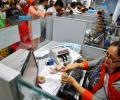
State Bank of India-led public sector banks posted a record cumulative profit of Rs 49,456 crore in the second quarter of the current fiscal, reflecting a 9 per cent year-on-year growth despite two lenders reporting a decline. All 12 public sector banks (PSBs) together made a profit of Rs 45,547 crore in the September quarter of FY25.

Tata Motors Passenger Vehicles (TMPV) on Friday reported a 13 per cent year-on-year (Y-o-Y) decline in consolidated revenue from operations for the second quarter of 2025-26 (Q2FY26), largely due to the cyberattack on its subsidiary Jaguar Land Rover (JLR) in late August that forced a shutdown of its manufacturing operations for over five weeks.

Do home prices really never fall? Ramalingam Kalirajan begs to differ.

This is the longest winning streak for gold in the last three decades.

Hindustan Unilever Ltd's (HUL's) second quarter 2025-26 (Q2FY26) consolidated revenue rose 2 per cent to Rs 16,250 crore, with low or flat volume growth. Demand remained stable but goods and services tax (GST) transition and prolonged monsoon hurt offtake.

Global fund managers witnessed one of their largest-ever declines in assets under custody (AUC) during the ongoing correction in the Indian markets, as stocks came under pressure from foreign outflows and the weakening rupee.

'If you see another 1000-point correction, people may start panicking.'

'India needs at least 70,000 to 80,000 eyewear stores; our 2,000 stores are just a drop in the ocean.'

The stock of India's largest listed pure play retail major Trent was down 14.76 per cent at close on Monday after a fall in revenue growth for the March quarter of 2024-25 (Q4FY25). The sales growth trajectory has been in a declining trend over the last few quarters, which, coupled with falling operational metrics, higher competitive intensity, and expensive valuations, has seen the stock crack about 44 per cent since its 52-week highs in October last year.

Ask rediffGURU and tax expert Mihir Tanna your income tax-related questions.

Wall Street-correlated stock markets are facing the risk of correction, as Christopher Wood, the global head of equity strategy at Jefferies, conveys to investors in his latest edition of GREED & fear. Rising crude oil prices, which are nearing $100 a barrel (Brent), pose a threat to the global central bank's battle against inflation and have led to a re-evaluation of its exposure to Indian stocks. "The potential for more US Federal Reserve (Fed) rate hikes, combined with the risk that monetary tightening finally bites as regards the economy, remains a risk for Wall Street-correlated world stock markets. "There is also the oil factor. This is why GREED & fear continues to believe the pain trade is down. "Areas in Asia, such as Indian midcaps, which have already done very well, are at obvious risk of some profit-taking," writes Wood.

From the 30-share Sensex pack, Tata Consultancy Services, Infosys, NTPC, HCL Technologies, Axis Bank, Tech Mahindra, Bajaj Finserv, Sun Pharma, IndusInd Bank and Reliance Industries were the major laggards. Tata Steel, Hindustan Unilever, Mahindra & Mahindra, Nestle and State Bank of India were among the gainers.

Indian stock markets are expected to be driven mostly by global factors this week amid a lack of local triggers and earnings season largely coming to an end, say analysts. Crude oil prices, rupee movement and US Federal Reserve meeting minutes to be released this week will also influence the market sentiment. "With the earnings season behind us, global cues would largely dictate the trend in the coming week," Ajit Mishra, SVP - technical research, Religare Broking Ltd, said.

Investors' wealth eroded by Rs 9.51 lakh crore on Monday morning, following a crash in equity markets where the benchmark Sensex tanked over 2,400 points, mirroring a sharp plunge in global peers. The 30-share BSE benchmark tanked 2,401.49 points to 78,580.46 in early trade. Following the sharp decline in equities, the market capitalisation of BSE-listed firms dropped by Rs 9,51,771.37 crore to Rs 4,47,65,174.76 crore ($5.35 trillion) during the morning trade.
On the eve of the Budget, top foreign brokerage houses Morgan Stanley and JP Morgan were advising investors to stay away from the Indian stock markets, saying the risk factors involved in Indian equities are much higher.

Domestic institutional investors pumped Rs 2.3 trillion into equities during H1 CY24. Of this, mutual funds contributed 80%.
Market experts see interest in Indian equities given the strong economic growth, robust earnings and rising domestic consumption.

Equity markets would be mainly driven by global trends and foreign fund trading activity in the holiday-shortened week, analysts said. The BSE and the National Stock Exchange have listed March 7 (Tuesday) as a holiday on account of Holi. However, stock brokers' association ANMI has urged the government, exchanges and Sebi to shift the holiday to March 8 from March 7.

Reliance Industries Ltd, India's largest buyer of Russian oil and most impacted by the latest US sanctions, on Friday said it will comply with all applicable restrictions and will adjust its refinery operations to meet compliance requirements.

Equity benchmark indices Sensex and Nifty bounced back on Thursday to close higher by nearly 1 per cent on gains in banking, IT and auto shares amid mixed global trends. The 30-share BSE Sensex rose by 443.19 points or 0.86 per cent to settle at 52,265.72. During the day, it rallied 694.26 points or 1.33 per cent to 52,516.79. The NSE Nifty advanced 143.35 points or 0.93 per cent to 15,556.65.

Shares of Oil marketing companies (OMCs) extended their gains for the fourth consecutive session on Thursday after crude oil prices plunged to six-month lows in the international markets, which boosted investor sentiments. Traders said the OMC stocks gained with crude oil prices hovering below $70 per barrel after OPEC-plus decision to increase output from April, a move which is expected to favour Indian refiners with added marketing margins on retail fuel.
The domestic stock market this week would monitor the geopolitical developments after India and Pakistan reached an understanding to stop military actions, analysts said. Moreover, macroeconomic data announcements, Q4 earnings, trading activity of foreign investors and global market trends are also likely to influence sentiments, traders said.

A profile of C.P. Radhakrishnan, the Maharashtra Governor and former MP, who is being considered as a potential Vice President candidate. His political journey, association with RSS and Jan Sangh, and his influence in Tamil Nadu politics are highlighted.

The IPO wave of 2025 is here, and it's bigger than ever. From fintech unicorns to financial powerhouses and infrastructure giants, some of India's biggest names are all set to make their stock market debut. PhonePe, Zepto, Tata Capital, NSE, NSDL, and JSW Cement are just a few of the highly awaited listings that have investors and analysts buzzing with excitement.

Market reaction to the Union Budget was overall neutral. The income tax "gift" wasn't enough to move the needle. There was some apparent rationalisation of Customs duty structure as well as cuts on import duties of some key components for the telecom and IT industry and duty cuts on vehicle imports. Other proposals related to development of agriculture and rural economy and renewables seem to be generally positive.

Who else will take on the might of Microsoft, Google, and Amazon if not the Adanis, Ambanis, Birlas, or Tatas?, asks R Jagannathan.

Among Sensex firms, Tata Steel jumped the most by 5.90 per cent. Titan, Mahindra & Mahindra, ITC, Eternal, State Bank of India, and Trent were among the other gainers. However, Infosys, NTPC, Hindustan Unilever, TCS, Adani Ports and Bharti Airtel were among the laggards.

The heightened global uncertainty due to the US "reciprocal tariffs" on India may cause near-term corrections and market turbulence, but the long-term outlook remains constructive, market experts said on Thursday. The US has announced 27 per cent reciprocal tariffs on India, citing high import duties imposed by New Delhi on American goods.
